what is actor isolation?
Asked on 2024-07-30
1 search

Actor isolation in Swift is a concurrency model that ensures that only one task can access an actor's state at a time, thereby preventing data races and ensuring thread safety. Actors are similar to classes in that they are reference types that can encapsulate shared mutable state. However, actors automatically protect their state by serializing accesses, meaning that only a single task is allowed to execute at a time on an actor. Calls to actor methods from outside the context of the actor are asynchronous.
For example, in the session A Swift Tour: Explore Swift’s features and design, it is explained that actors serialize accesses to their state, ensuring that only one task can execute at a time on an actor. This makes concurrent accesses to shared state safe.
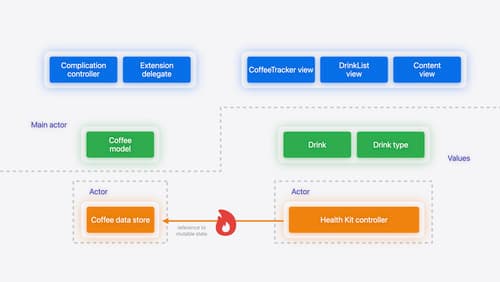
In the session Migrate your app to Swift 6, it is highlighted that Swift 6 introduces full enforcement of data isolation, preventing accidental sharing of state between tasks and actors. This helps in catching concurrency bugs at compile time, improving the quality of the app.
Additionally, the concept of "assume isolated" is discussed in the same session, which allows developers to tell the compiler that a certain piece of code is already running on a specific actor, without starting a new task. This is useful for ensuring that certain methods are always called on the main actor, for example.
For more detailed information, you can refer to the chapter on Concurrency in the session "A Swift Tour: Explore Swift’s features and design" and the chapter on Delegate callbacks and concurrency in the session "Migrate your app to Swift 6".

A Swift Tour: Explore Swift’s features and design
Learn the essential features and design philosophy of the Swift programming language. We’ll explore how to model data, handle errors, use protocols, write concurrent code, and more while building up a Swift package that has a library, an HTTP server, and a command line client. Whether you’re just beginning your Swift journey or have been with us from the start, this talk will help you get the most out of the language.
Migrate your app to Swift 6
Experience Swift 6 migration in action as we update an existing sample app. Learn how to migrate incrementally, module by module, and how the compiler helps you identify code that’s at risk of data races. Discover different techniques for ensuring clear isolation boundaries and eliminating concurrent access to shared mutable state.
What’s new in Swift
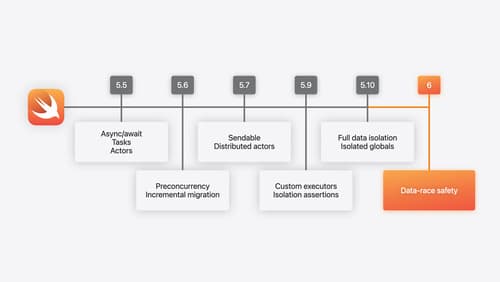
Join us for an update on Swift. We’ll briefly go through a history of Swift over the past decade, and show you how the community has grown through workgroups, expanded the package ecosystem, and increased platform support. We’ll introduce you to a new language mode that achieves data-race safety by default, and a language subset that lets you run Swift on highly constrained systems. We’ll also explore some language updates including noncopyable types, typed throws, and improved C++ interoperability.