Executor
Asked on 2026-03-25
1 search

The concept of "Executor" in the context of Swift concurrency is not explicitly mentioned in the provided segments from the WWDC sessions. However, the sessions do cover related topics such as concurrency, actors, and task management in Swift.
For example, the session titled "Embracing Swift concurrency" discusses how tasks can be managed and executed in a concurrent environment, including the use of actors to isolate state and manage concurrency safely. This session also covers the use of asynchronous tasks and how they can be interleaved to improve performance.
If you are interested in learning more about how Swift handles concurrency and task execution, you might want to explore the session Embracing Swift concurrency which provides a comprehensive overview of these topics.
Embracing Swift concurrency
Join us to learn the core Swift concurrency concepts. Concurrency helps you improve app responsiveness and performance, and Swift is designed to make asynchronous and concurrent code easier to write correctly. We’ll cover the steps you need to take an app through from single-threaded to concurrent. We’ll also help you determine how and when to make the best use of Swift concurrency features – whether it’s making your code more asynchronous, moving it to the background, or sharing data across concurrent tasks.

Code-along: Elevate an app with Swift concurrency
Learn how to optimize your app’s user experience with Swift concurrency as we update an existing sample app. We’ll start with a main-actor app, then gradually introduce asynchronous code as we need to. We’ll use tasks to optimize code running on the main actor, and discover how to parallelize code by offloading work to the background. We’ll explore what data-race safety provides, and work through interpreting and fixing data-race safety errors. Finally, we’ll show how you can make the most out of structured concurrency in the context of an app.
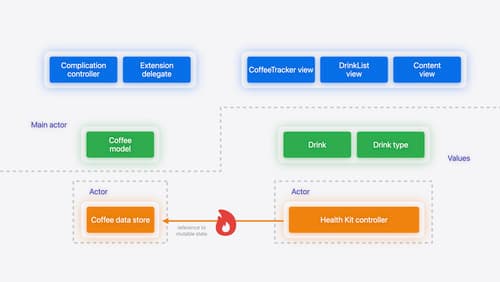
Migrate your app to Swift 6
Experience Swift 6 migration in action as we update an existing sample app. Learn how to migrate incrementally, module by module, and how the compiler helps you identify code that’s at risk of data races. Discover different techniques for ensuring clear isolation boundaries and eliminating concurrent access to shared mutable state.