What are the uses of the Observation framework and the Combine framework?
Asked on 2026-01-09
1 search
The Observation framework and the Combine framework are both used for handling state changes and data flow in Swift applications, but they serve different purposes and have distinct features.
Observation Framework
The Observation framework provides general-purpose APIs for automatically tracking state changes in an object graph. It allows developers to opt a class into observation tracking using the observable macro. This framework is particularly useful for streaming state changes with an async sequence from an observable type. It ensures that updates happen transactionally, meaning that synchronous updates to multiple properties don't lead to observation updates with the object in an inconsistent state. This is particularly useful in SwiftUI, where views can automatically update in response to changes in observable properties. For more details, you can refer to the session What’s new in Swift.
Combine Framework
While the context provided does not specifically mention the Combine framework, it is generally known that Combine is used for handling asynchronous events by providing a declarative Swift API for processing values over time. It is often used for tasks like network requests, user interface updates, and other asynchronous operations. Combine allows developers to chain operations and handle events in a more structured way, using publishers and subscribers to manage data flow and state changes.
Both frameworks are integral to building responsive and efficient Swift applications, with Observation focusing more on state tracking and Combine on handling asynchronous data streams.

What’s new in Swift
Join us for an update on Swift. We’ll talk about workflow improvements that make you more productive, and new and modernized library APIs for fundamental programming tasks. We’ll show examples of Swift adoption throughout more layers of the software stack. Finally, we’ll explore new language features for both improving approachability of concurrency, and achieving peak performance when you need it.
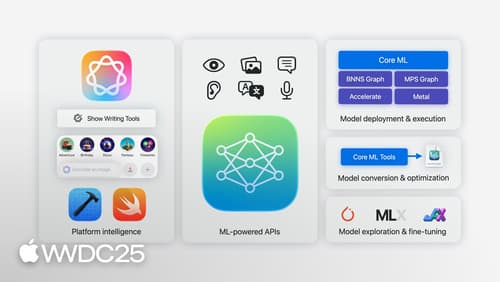
Discover machine learning & AI frameworks on Apple platforms
Tour the latest updates to machine learning and AI frameworks available on Apple platforms. Whether you are an app developer ready to tap into Apple Intelligence, an ML engineer optimizing models for on-device deployment, or an AI enthusiast exploring the frontier of what is possible, we’ll offer guidance to help select the right tools for your needs.
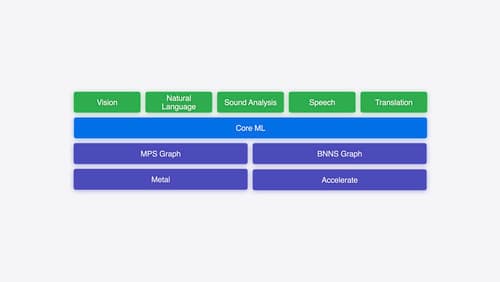
Explore machine learning on Apple platforms
Get started with an overview of machine learning frameworks on Apple platforms. Whether you’re implementing your first ML model, or an ML expert, we’ll offer guidance to help you select the right framework for your app’s needs.